

CAMPAIGN UPDATES
Labour commits to reforming Progress 8
We are delighted that in a recent speech to the Labour Creatives conference on 14 March, Sir Keir Starmer committed to reforming Progress 8. The Labour leader said that accountability measures had caused a ‘creativity crisis in schools’ and announced that ‘…from day one, Labour will reform the school accountability framework, to make sure arts count. We will update the Progress 8 performance measure… Use it to help all children study a creative arts subject, or sport, until they are 16.’ The reform would mean that a creative or vocational subject has to be included in the third Progress 8 bucket.
We also welcome Labour's commitment to putting creativity 'at the heart of the curriculum'. We will be writing to the other major political parties ahead of the General Election to seek similar commitments.
We are delighted that in a recent speech to the Labour Creatives conference on 14 March, Sir Keir Starmer committed to reforming Progress 8. The Labour leader said that accountability measures had caused a ‘creativity crisis in schools’ and announced that ‘…from day one, Labour will reform the school accountability framework, to make sure arts count. We will update the Progress 8 performance measure… Use it to help all children study a creative arts subject, or sport, until they are 16.’ The reform would mean that a creative or vocational subject has to be included in the third Progress 8 bucket.
We also welcome Labour's commitment to putting creativity 'at the heart of the curriculum'. We will be writing to the other major political parties ahead of the General Election to seek similar commitments.
Response to our open letter from the DfE
The Department for Education (DfE) finally replied to our open letter of 19 July in November. The DfE's response includes a number of highly questionable assertions, including about the uptake of arts subjects in schools and funding for arts education.
We have issued a statement that challenges and clarifies these assertions. We also highlight the fact that the influential House of Lords' Education for 11-16 Year Olds Committee has just published its report, which calls for the EBacc to be scrapped and Progress 8 to reformed. We have sent a copy of the statement to the new Minister for School Standards, Damian Hinds.
The Department for Education (DfE) finally replied to our open letter of 19 July in November. The DfE's response includes a number of highly questionable assertions, including about the uptake of arts subjects in schools and funding for arts education.
We have issued a statement that challenges and clarifies these assertions. We also highlight the fact that the influential House of Lords' Education for 11-16 Year Olds Committee has just published its report, which calls for the EBacc to be scrapped and Progress 8 to reformed. We have sent a copy of the statement to the new Minister for School Standards, Damian Hinds.
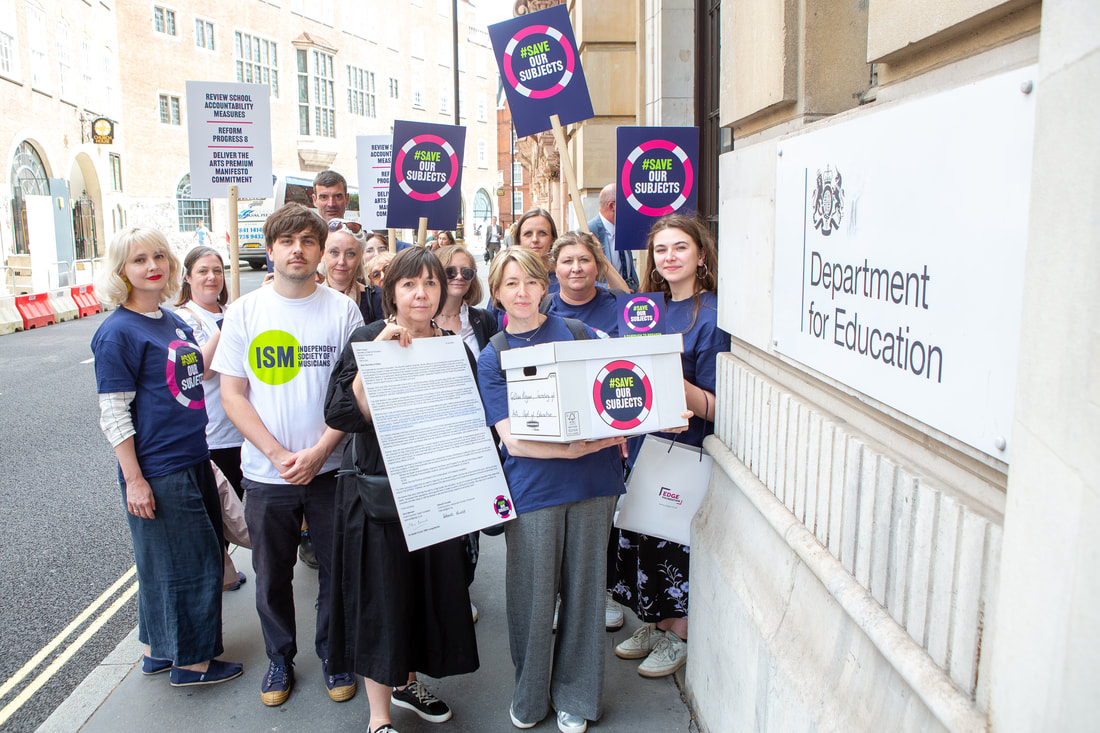
On Wednesday 19 July 2023, the #SaveOurSubjects campaign, including representatives from the Independent Society of Musicians (ISM), the Edge Foundation, NSEAD, Action for Children’s Arts, the Sixth Form Colleges’ Association and One Dance handed in a letter to the Department for Education for the Education Secretary, Gillian Keegan.
The letter has been signed by over 1,200 people, including high-profile signatories such as classical music luminaries Alice Coote, Ian Bostridge, Julius Drake, Mark Elder, Gerald Finley, Jeremy Huw Williams, Mark Padmore and Nicky Spence; broadcasters Petroc Trelawney and Sean Rafferty; Baroness Sue Nye and Sir Christopher Frayling, plus the general secretaries of the National Education Union, Mary Bousted and Kevin Courtney, as well as chief executives of a wide range of arts organisations and subject associations.
The letter hand-in comes as the Labour Party announced it would reform Progress 8 if in government to ensure students can 'enjoy music, sport, art, drama, and develop the knowledge and skills they need to thrive throughout life'.
Commenting on the campaign, ISM Chief Executive Deborah Annetts said, 'The rate at which arts subjects are disappearing from our schools is both staggering and frightening. The support for our letter to Gillian Keegan clearly demonstrates the level of concern. ISM research and plenty more has shown that the reasons behind this are largely due to the EBacc and Progress 8 accountability measures. Students deserve to be taught a truly broad and balanced curriculum that gives them the skills for the 21st-century workplace.
'That’s why the Secretary of State should read the letter we have delivered today carefully, listen to our campaign, reform Progress 8 and provide the Arts Premium that it promised. There is a growing list of individuals and organisations who wish to see government take action, including former Conservative Education Secretary Lord Kenneth Baker, who has called for reform.'
Edge Chief Executive, Alice Barnard said, 'Edge has long been calling for a broader and more balanced curriculum that develops the skills young people need to become well-rounded individuals and productive members of society. But this is not just an economic imperative. The arts and creative subjects have the potential to positively impact mental health and wellbeing, as well as providing young people with sense of purpose. A broad curriculum is the best to develop well-rounded learners, to unlock opportunity for young people and to create a more equitable society all round.'
The letter has been signed by over 1,200 people, including high-profile signatories such as classical music luminaries Alice Coote, Ian Bostridge, Julius Drake, Mark Elder, Gerald Finley, Jeremy Huw Williams, Mark Padmore and Nicky Spence; broadcasters Petroc Trelawney and Sean Rafferty; Baroness Sue Nye and Sir Christopher Frayling, plus the general secretaries of the National Education Union, Mary Bousted and Kevin Courtney, as well as chief executives of a wide range of arts organisations and subject associations.
The letter hand-in comes as the Labour Party announced it would reform Progress 8 if in government to ensure students can 'enjoy music, sport, art, drama, and develop the knowledge and skills they need to thrive throughout life'.
Commenting on the campaign, ISM Chief Executive Deborah Annetts said, 'The rate at which arts subjects are disappearing from our schools is both staggering and frightening. The support for our letter to Gillian Keegan clearly demonstrates the level of concern. ISM research and plenty more has shown that the reasons behind this are largely due to the EBacc and Progress 8 accountability measures. Students deserve to be taught a truly broad and balanced curriculum that gives them the skills for the 21st-century workplace.
'That’s why the Secretary of State should read the letter we have delivered today carefully, listen to our campaign, reform Progress 8 and provide the Arts Premium that it promised. There is a growing list of individuals and organisations who wish to see government take action, including former Conservative Education Secretary Lord Kenneth Baker, who has called for reform.'
Edge Chief Executive, Alice Barnard said, 'Edge has long been calling for a broader and more balanced curriculum that develops the skills young people need to become well-rounded individuals and productive members of society. But this is not just an economic imperative. The arts and creative subjects have the potential to positively impact mental health and wellbeing, as well as providing young people with sense of purpose. A broad curriculum is the best to develop well-rounded learners, to unlock opportunity for young people and to create a more equitable society all round.'
On Thursday 11 May 2023, Deborah Annetts (Chief Executive at the ISM), Olly Newton (Executive Director at Edge Foundation), Dr Geoffrey Readman (Chair at National Drama) and Tony Ryan (Chief Executive at the Design and Technology Association) gave evidence to the House of Lords Committee on Education for 11 - 16 Year Olds. The Committee also heard from Carolyn Roberts (Co-Director of Prince's Teaching Institute) and Dr Hilary Leevers (CEO at EngineeringUK) at two earlier sessions.
|
|
|
On 24 April 2023, the Royal Society of the Arts held an event called 'The changing face of 21st century learning'. Andy Haldane (Chief Executive of the RSA) was joined by Rachel Sylvester (Chair of the Times Education Commission), The Rt Hon David Blunkett (former Secretary of State for Education) and Lord Kenneth Baker (Chair of the Baker Dearing Educational Trust) to discuss the case for a 'radical re-think' of education in the 21st Century.
Lord Baker spoke about the impact of both the EBacc and Progress 8 on arts and technology subjects.
Lord Baker spoke about the impact of both the EBacc and Progress 8 on arts and technology subjects.
|
|
|
|
NEWS ARTICLES
- Rachel Landon, CEO of Music in Secondary Schools Trust, talks to GB News on the importance of music funding in state schools, July 2023
- Give classroom bean-counters a handbagging, The Times, July 2023
- Labour accuses UK government of ‘stifling children’s creativity', The Guardian, June 2023
- Would you sacrifice a GCSE grade for a more holistic education?, tes, June 2023
- GCSEs and A levels: How to entice more students to sit arts exams, tes, June 2023
- The Guardian view on arts education: a creativity crisis, The Guardian, February 2023
- Cost of living: Red Wall children missing out on art, drama and music as crisis hits schools, parents say, The i, December 2022
- A rich life in the UK’s creative industries is a long shot if you are born poor, The Guardian, December 2022
- State-school past of top composers is a lesson for future, The Times, November 2022
- Art, drama and languages to become ‘preserve of private schools’ as state sector cuts bite, The Guardian, November 2022